
Trousers
Garment covering each leg separately, worn from waist to knee or ankle.

Wikipedia / Wikimedia Commons
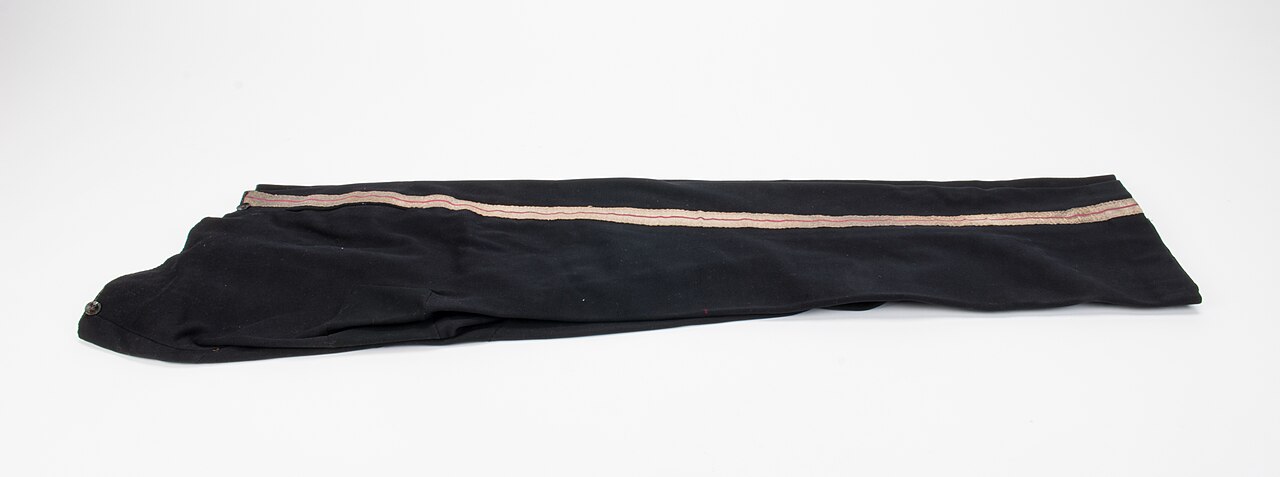
Trousers are an item of clothing worn from the waist to anywhere between the knees and the ankles, covering both legs separately. They are known by various regional names, including slacks in Southern British English and pants in Northern British English, American, Canadian, and Australian English. Trousers have been a common form of lower-body clothing for adult males in most of Europe since ancient times and throughout the Medieval period, and since the mid-twentieth century have increasingly been worn by women as well.
- oldest known example
- 13th–10th century BC, Yanghai cemetery, Turpan, Xinjiang, western China
- material of oldest known
- wool
- earliest related garment
- trouser-like leggings, 3350–3105 BC, Austria–Italy border (worn by Ötzi)
- common modern materials
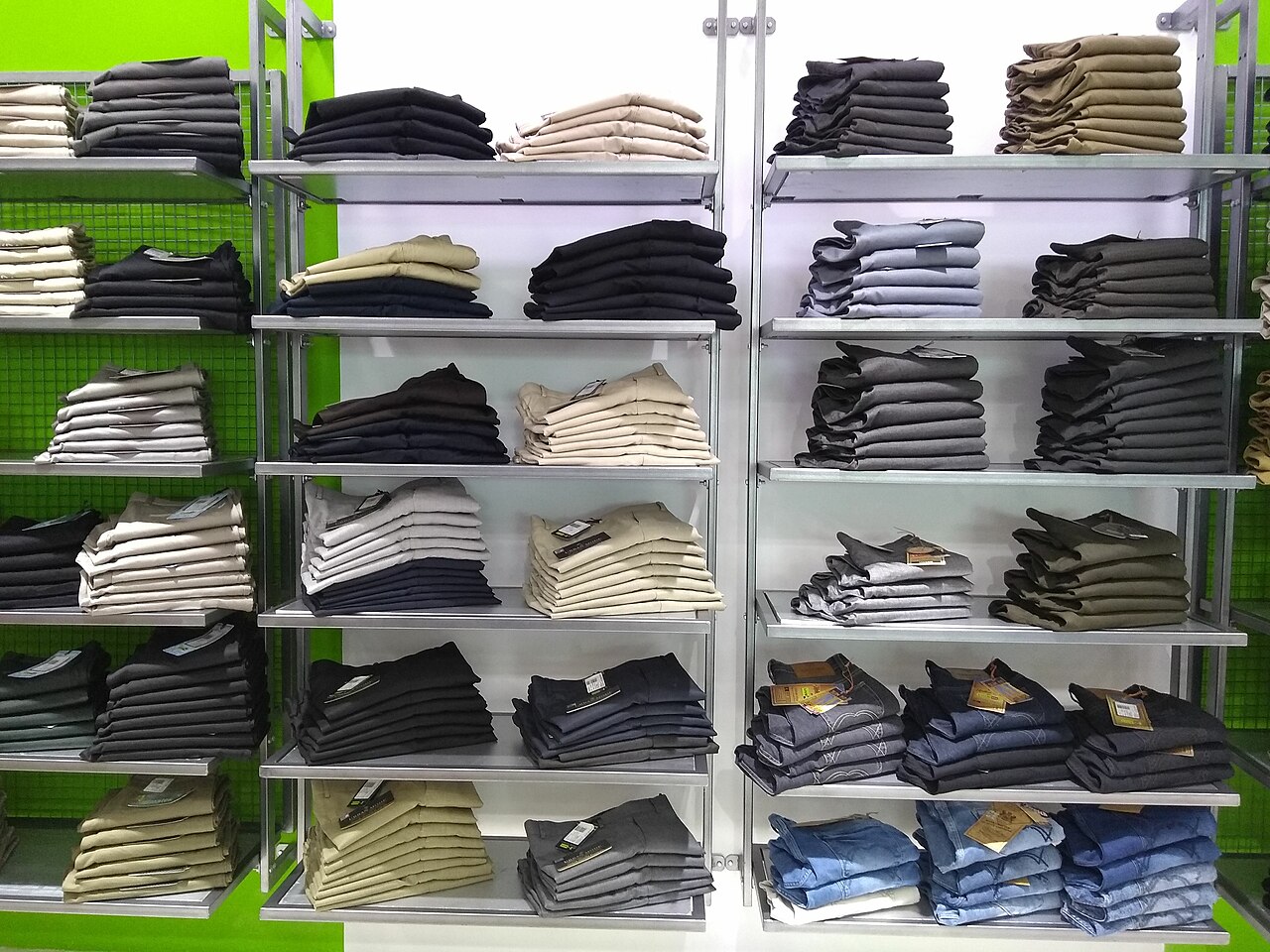
- denim (for jeans), wool, cotton, silk, leather
- regional terms
- trousers (Southern British English), slacks, pants (Northern British English, American, Canadian, Australian English), trews (Scots), breeks (Scots)
Lore & Background
The oldest known trousers, dating between the thirteenth and tenth centuries BC, were found at the Yanghai cemetery in Turpan, Xinjiang (Tocharia), in present-day western China. Made of wool, they had straight legs and wide crotches and were likely made for horseback riding. A pair of trouser-like leggings dating back to 3350–3105 BC was found on the Austria–Italy border, worn by Ötzi. In most of Europe, trousers have been worn since ancient times and throughout the Medieval period, becoming the most common form of lower-body clothing for adult males in the modern world. Breeches were worn instead of trousers in early modern Europe by some men in higher classes of society.
Reader's Guide
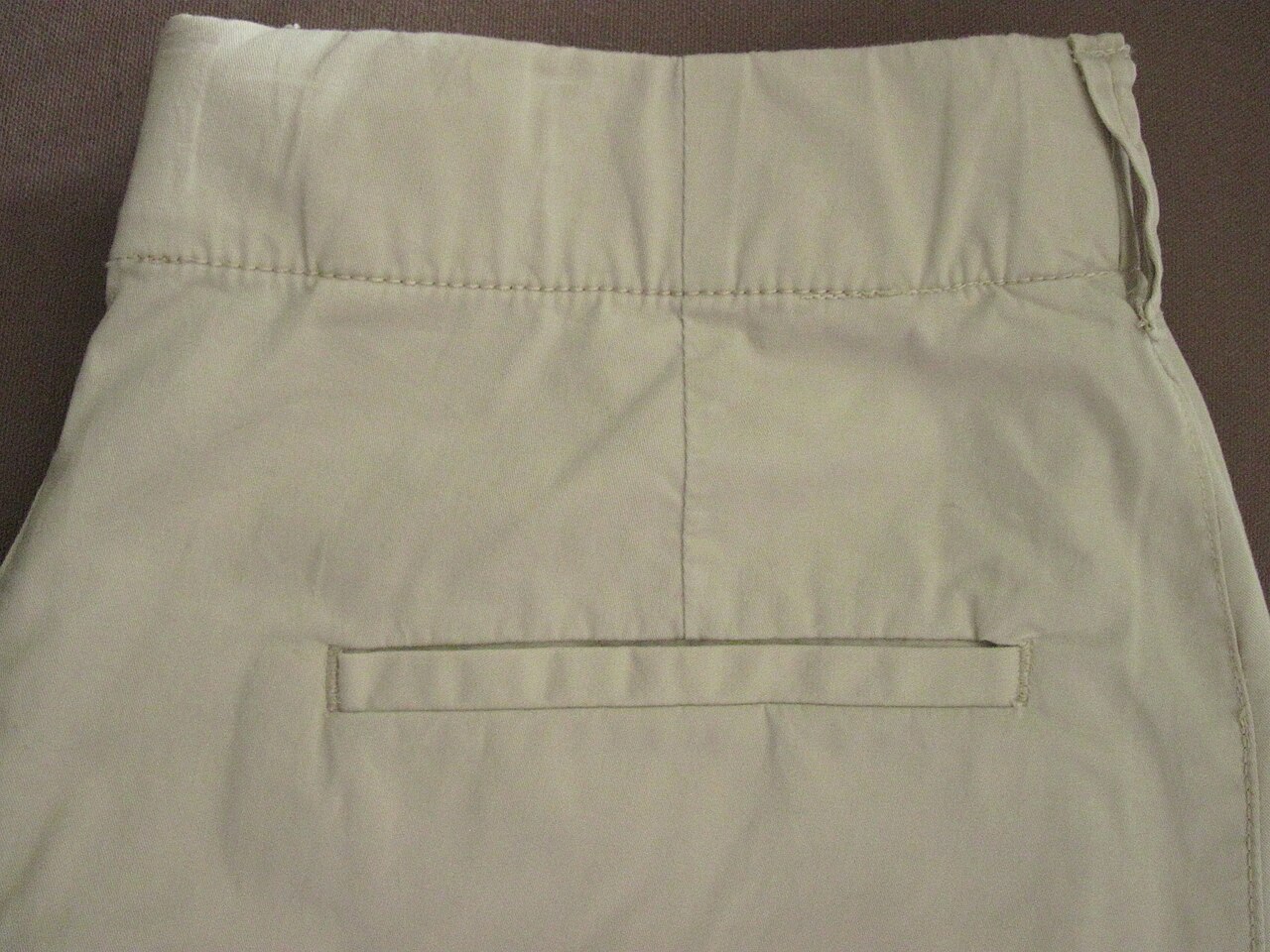
Trousers are a fundamental garment in global dress, with a history stretching back over three millennia. The earliest known examples, from the Tarim Basin, were designed for horseback riding, indicating a functional origin. Over time, trousers became standard attire for men in Europe and, from the mid-twentieth century, for women as well. Regional terminology varies: in Scotland, the word 'trousers' derives from Gaelic 'triubhas', and the garment is also called 'trews' or 'breeks'. In North America, Australia, and South Africa, 'pants' is the general term, while 'trousers' or 'slacks' often refers to tailored garments with waistbands and fly-fronts. Jeans, made of denim, are a widely worn casual form of trousers. Maintenance of fit can be challenging; leg length is adjustable with a hem, and higher-quality trousers often include extra fabric in the centre-back seam to allow waist expansion. Trousers are typically pluralia tantum, with 'pair of trousers' being the standard form.
Did You Know?
- The oldest known trousers, made of wool, were found at the Yanghai cemetery in western China and date to between the thirteenth and tenth centuries BC.
- A pair of trouser-like leggings worn by Ötzi was found on the Austria–Italy border, dating to 3350–3105 BC.
- In Scotland, tartan trousers called trews are sometimes worn instead of the kilt at ceilidhs and weddings.
- The word 'trousers' derives from the Gaelic 'triubhas'.
Ancient and Nomadic Origins
Long before trousers became a universal wardrobe staple, their earliest recorded use traces back to nomadic steppe peoples of Western Europe—groups of diverse ethnicities roaming the vast Eurasian grasslands. Archaeological findings from this cultural context reveal that both men and women donned trousers, suggesting the garment was not originally gendered. In Mycenaean Greece, dating roughly from 1750 to 1050 BCE, surviving imagery hints that both sexes wore primitive versions of the garment. By contrast, classical Greece and Rome largely eschewed trousers in favour of tunics, with Roman women draped in a stola and men in a toga. The Germanic peoples, however, generally dressed their men in long trousers, with women occasionally adopting the same style. In the ancient Near East, Egyptians and Mesopotamians favoured aprons, robes, cloaks, and knee-length skirts rather than trousers. Persians stood apart: every member of society, regardless of sex, wore form-fitting trousers, later supplementing them with cloaks borrowed from Assyrian neighbours. Other Iranian and Central Asian groups—Scythians, Sarmatians, Sogdians, Bactrians, Armenians, and the Xiongnu—all appear to have worn trousers across both genders.
Legal Barriers and Their Enforcement
For over two centuries, women in Paris faced a legal prohibition on wearing trousers without police authorisation—a rule that technically persisted from 1800 until 2013. Enforcement largely lapsed during and after the First World War. In the 1850s, painter Rosa Bonheur had to petition the police for permission to wear trousers, her preferred attire for studying livestock at the markets. Across the Atlantic, American cities enacted their own bans. San Francisco criminalised appearing in public in clothing "not belonging to his or her sex" in 1863, but similar ordinances had already been passed in Columbus, Ohio (1848), Chicago (1851), Houston (1864), and Orlando (1907), among two dozen other municipalities. Detroit and Miami continued passing such restrictions into the late 1950s. Beyond explicit dress codes, anti-vagrancy statutes became tools of enforcement. New York's 1845 vagrancy law targeted anyone appearing in a "disguise" calculated to prevent identification, and prosecutors wielded it against women dressed outside gender norms. In 1852, Boston authorities detained Emma Snodgrass and her companion Harriet French under similar provisions; both were arrested again in later years. In 1882 and 1883, Jennie Westbrook was hauled before New York courts on the same grounds, a case that drew public attention.
Defiance, Dress Reform, and the Push for Freedom
Women who defied the dress codes of their era did so for compelling reasons: physical comfort, greater freedom of movement, personal style, the need for disguise (notably among runaway slaves), the desire to close the gender pay gap, and the wish to project an empowered public identity. In 1851, Elizabeth Smith Miller introduced Amelia Bloomer to a garment initially called the "Turkish dress"—a knee-length skirt worn over Turkish-style pantaloons. Bloomer championed the style in The Lily, a newspaper dedicated to women's emancipation. The outfit sparked a craze and became known simply as bloomers. Stanton, Anthony, and Stone adopted the look in the 1850s, dubbing it the "freedom dress." Meanwhile, in the coal pits of the Wigan area, working women called pit brow women began wearing trousers beneath a short skirt as a practical part of their uniform, drawing public and photographic attention through the later nineteenth century. Harriet French told the New York Daily Times she could "get more wages" dressed as a man, and Jennie Westbrook explained she could earn twenty dollars a week in disguise versus only a third of that as a store saleslady. Mary Edwards Walker also advocated publicly for dress reform.
Enduring Religious Norms and Modern Normalisation
By the twentieth and twenty-first centuries, the customs and laws that once policed women's wardrobes had relaxed dramatically, and trousers became a normal, widely accepted part of women's everyday dress. This shift reflected a broader cultural rethinking of gender and clothing, turning what had been a source of legal prosecution and social censure into an unremarkable fashion choice. Yet the norm has not vanished entirely. Several religious communities continue to teach that women should wear full-length dresses rather than trousers, viewing the distinction as essential to maintaining a clear separation between the sexes. Orthodox Jewish communities, Conservative Anabaptist groups, and the Methodists of the conservative holiness movement all uphold this teaching, treating the garment choice as a matter of religious obligation rather than personal preference. The history of trousers thus encapsulates a broader tension: between individual freedom of expression and collective religious or cultural prescription, between the practical needs of the body and the symbolic meanings societies attach to how that body is clothed. What began as a practical garment for nomadic peoples on the Eurasian steppe has become, in the modern era, a site of ongoing negotiation between liberty and tradition.
Gallery

Frequently Asked Questions
Who is Trousers?
Trousers is a lower-body garment that covers each leg individually, stretching from the waist down to a point between the knee and the ankle. In the Clothing And Accessories series (entry 1-19), it represents one of humanity's most long-standing forms of legwear.
What are Trousers's powers/role?
Trousers serve as a practical, two-legged covering that keeps the lower body warm and protected while permitting free, independent movement of each leg. They have functioned as standard adult male attire across most of Europe since ancient and Medieval times, and from the mid-twentieth century onward they became increasingly common among women as well.
How does Trousers's story end?
Trousers has no fixed narrative conclusion, since the garment keeps evolving with new fabrics like denim, cotton, silk, and leather. Its story remains open-ended, with regional naming variants such as pants, slacks, trews, and breeks showing it is still very much in active cultural use.
Why is Trousers important?
Trousers carry deep historical weight because the oldest known pair, made of wool, was unearthed at the Yanghai cemetery in Turpan, Xinjiang, dating to the 13th–10th century BC. Even earlier, Ötzi wore trouser-like leggings around 3350–3105 BC on the Austria–Italy border, making this garment one of the earliest examples of separate leg coverage.
What materials is Trousers made of?
The earliest known Trousers were crafted from wool, as evidenced by the roughly 3,000-year-old specimens from western China. In modern iterations, common materials include denim for jeans, alongside wool, cotton, silk, and leather.
More in Clothing And Accessories 1-19
Spotted an error? Know more?
This is a living reference — every entry is fact-audited, and reader corrections feed straight into our audit queue. Suggest an edit · See this site's audit record